 Korea Experience Finder
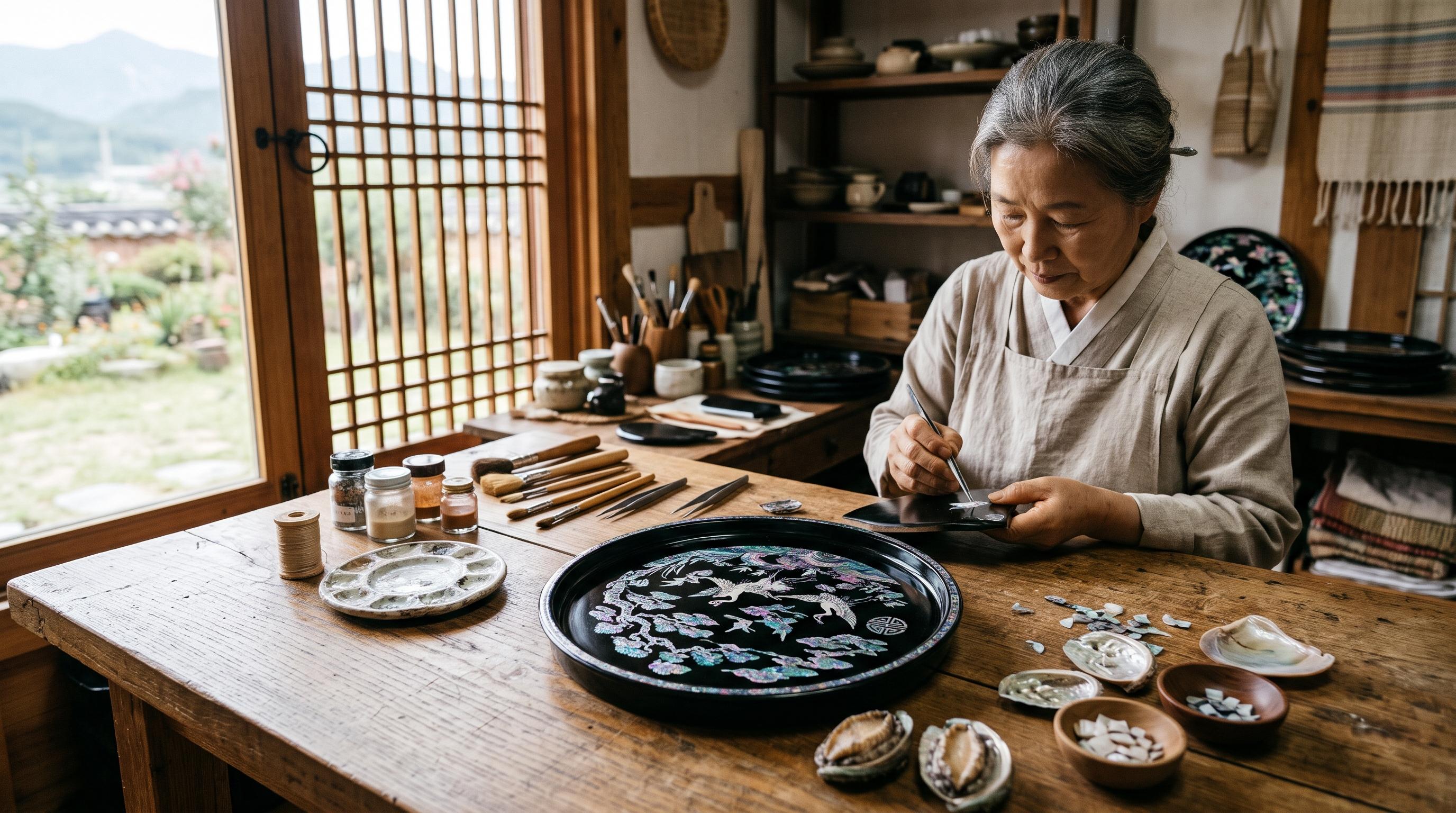
International travelers can join verified English-led mother-of-pearl workshops at Jinjooshell or Bukchon Traditional Crafts Center in Jongno, Hwiho Craft near Hapjeong, or modern studios in Myeongdong.
For travelers visiting South Korea who seek a hands-on cultural souvenir rather than a generic factory-made trinket, mother-of-pearl craft—historically known as najeonchilgi (나전칠기)—presents one of the most compelling artistic traditions in the peninsula. However, international visitors often encounter practical barriers: authentic full-cycle lacquer curing takes weeks, traditional master workshops rarely operate in foreign languages, and walk-in craft spaces sometimes offer rotating activities rather than daily mother-of-pearl sessions. This field guide outlines exactly where you can book and attend an English-instructed mother-of-pearl workshop across key Seoul districts, delineating the vital differences between centuries-old lacquer curing and modern quick-cure travel classes.
Understanding Traditional Najeonchilgi vs. Visitor One-Day Workshops
Traditional Korean najeonchilgi combines the brilliant iridescence of finely prepared marine shells (chiefly abalone, conch, or pearl oysters) with a base treated in natural tree lacquer (ottchil, 옻칠)1. Documented historically from the Goryeo and Joseon dynasties, authentic lacquerware traditionally centered in coastal craft hubs like Tongyeong requires up to 25 intricate procedural steps1. Raw sap harvested from lacquer trees must be refined, applied in thin layers, and left to harden under carefully calibrated ambient humidity and temperature1. A genuine historical najeonchilgi piece can take anywhere from 30 days to over a full year to achieve its glossy, scratch-resistant depth1.
Because raw tree lacquer contains urushiol—an active organic compound notorious for provoking severe allergic contact dermatitis—and requires prolonged curing timelines, genuine wet-lacquer techniques are not suitable for single-day tourism workshops9. Consequently, traveler-focused classes throughout Seoul provide pre-lacquered wooden or acrylic bases alongside pre-cut, paper-thin shell pieces. Instead of multi-week natural sap curing, modern workshop sessions utilize non-toxic jewelry glues, eco-friendly surface sealants, or fast-curing ultraviolet (UV) resin coats7. This engineered adaptation allows travelers to practice authentic layout, inlay styling, and precision tweezers work without health hazards, walking away with a cured, carry-on-ready souvenir within 60 to 90 minutes7.
Top Verified English-Friendly Workshop Locations Across Seoul
1. Bukchon Traditional Crafts Center (북촌전통공예체험관): Situated in the heart of Bukchon Hanok Village (24-5, Bukchon-ro 12-gil, Jongno-gu, approximately 670 meters from Anguk Station Exit 2 on Subway Line 3), this public cultural center operates year-round except on Lunar New Year and Chuseok holidays2. Standard admission to the center grounds is free, while rotating craft activities generally cost between 5,000 KRW and 15,000 KRW2. While walk-in activities rotate daily through various crafts like natural dyeing, hanji, and accessory making, the Seoul Metropolitan Government periodically organizes dedicated English-friendly international sessions, such as the monthly 'K-Craft Making Class'3. Priced at 13,000 KRW per international visitor, this program combines a 30-minute center tour with a 90-minute structured craft session capped at 20 participants, bookable four weeks in advance online3.
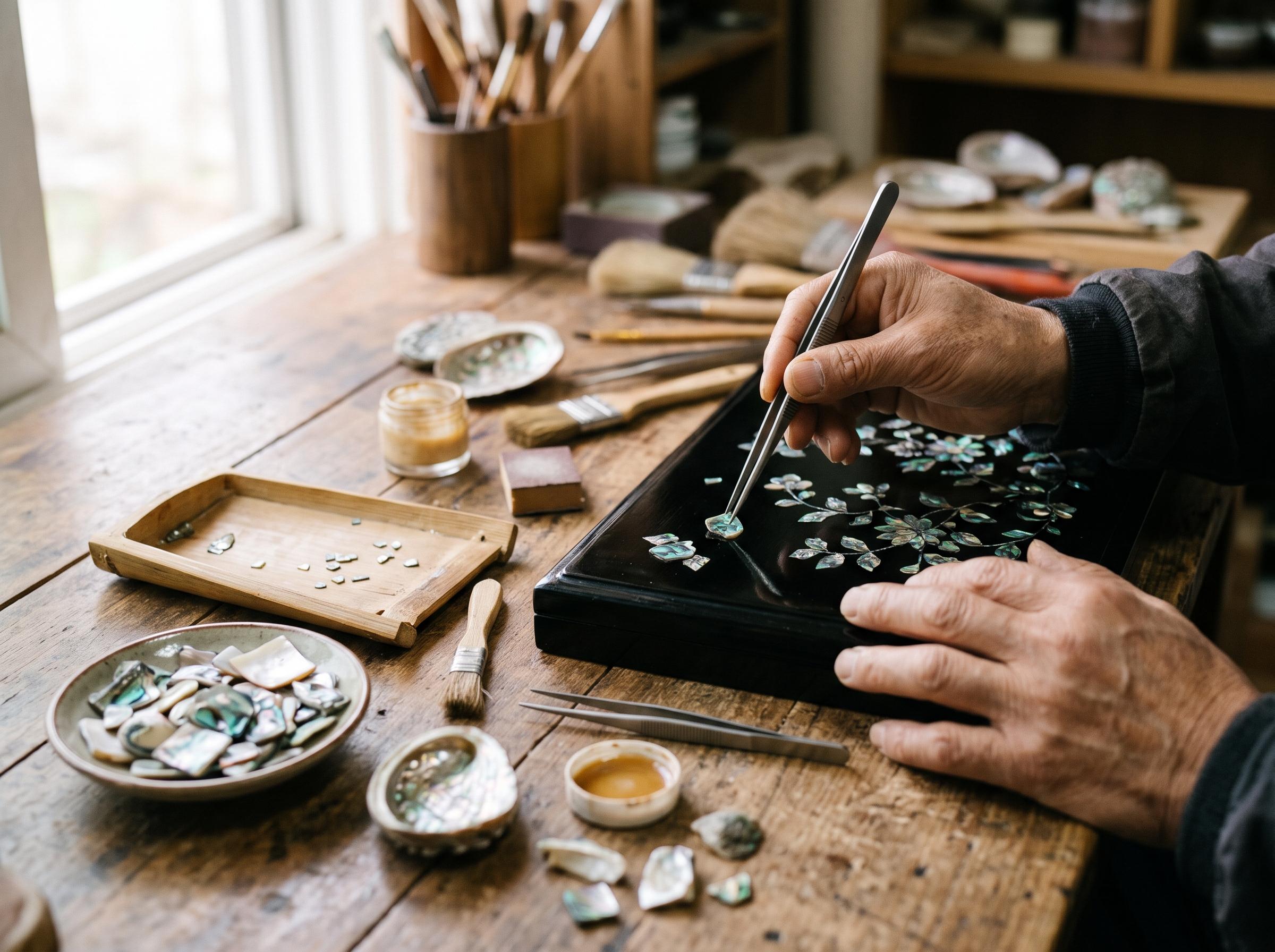
2. Jinjooshell Bukchon Studio (진주쉘): Operating privately within Bukchon at B1F, 42-3 Bukchon-ro (also accessible from Anguk Station), Jinjooshell is spearheaded by multi-generational shell artisans whose masterworks have been highlighted in prominent Korean television productions4. The studio offers structured 60-minute English workshops from Monday through Saturday (typically scheduled at 11:30 AM and 2:00 PM)45. Participants can choose project bases including foldable compact mirrors, hair ties, brooches, or business card cases, with introductory rates starting from approximately 16.00 to 24.00 USD (roughly 22,000 to 35,000 KRW depending on item selection and platform booking rates)45. Reservations must be completed two to three days in advance via official tourism channels such as Trazy or KoreaTravelEasy45.
3. Hwiho Craft (휘호크래프트): Located in western Seoul's Mapo-gu arts corridor (Room 401, 5 Dokmak-ro 2-gil, adjacent to Hapjeong Station), Hwiho Craft runs a focused 90-minute mother-of-pearl inlay workshop6. The studio accommodates up to nine participants per session, ensuring dedicated instructor attention in both English and Korean6. Participants can craft personalized compact mirrors, accessory boxes, or keychains incorporating both traditional Korean nature motifs and custom initials using Hangul or Roman alphabets6. Note that the workshop is located on the fourth floor of a walk-up building without an elevator, and venue policy strictly mandates that every attendee, including accompanying guardians with children, purchase an individual craft piece—passive observation is not permitted6.
4. Myeongdong Modern Accessory Studios (e.g., Seoul Piece): Centered around Myeongdong Station (Exit 3/4 corridors), boutique artisan spaces host modern 75-minute workshops listed on platforms like Airbnb Experiences and Trip.com78. These English-guided sessions prioritize lifestyle accessories like traditional decorative norigae (노리개) tassels, acrylic phone grips, keyrings, and decorative photo frames7. With quick-cure UV resin stations, creations can be sealed within minutes, making these studios particularly practical for travelers staying in central hotel districts who have tight touring schedules7.
| Workshop Venue | District / Transit | Session Length | Standard Price Range | Key Craft Items | Language & Booking Policy |
|---|---|---|---|---|---|
| Bukchon Traditional Crafts Center (Public) | Jongno-gu (Anguk Station Line 3) | 60–90 min | 5,000–15,000 KRW (Official program: 13,000 KRW) | Traditional accessories, hand mirrors, charms | Korean/English; Walk-ins welcome for daily rotating crafts, monthly Hallyu program requires online booking 4 weeks prior |
| Jinjooshell Bukchon Studio (Private) | Jongno-gu (Anguk Station Line 3) | 60 min | ~US$16.00–32.00 (~22,000–45,000 KRW by item) | Foldable compact mirrors, hairpins, card cases | English instructor; Advance reservation 2–3 days prior via Trazy or KoreaTravelEasy |
| Hwiho Craft (Independent Studio) | Mapo-gu (Hapjeong Station Line 2/6) | 90 min | ~US$35.00–55.00 (~48,000–75,000 KRW by item) | Accessory boxes, compact mirrors, custom keychains | English & Korean; Book via Viator/Marriott Activities; 4th-floor walk-up; All attendees must make a project |
| Myeongdong Accessory Studios (e.g., Seoul Piece) | Jung-gu (Myeongdong Station Line 4) | 75–90 min | ~US$30.00–45.00 (~40,000–60,000 KRW by item) | Norigae tassels, hairpins, phone grips, photo frames | English & Korean; Book via Airbnb Experiences or Trip.com; Rapid UV resin curing for instant take-home |
How to Select the Right Workshop for Your Travel Profile
Choosing the optimal workshop depends largely on group composition, budget, and logistical flexibility. If you are a solo traveler seeking spontaneous, budget-friendly cultural immersion, dropping by the Bukchon Traditional Crafts Center during an afternoon stroll through Gahoe-dong offers minimal commitment and low materials fees2. However, because the public center operates on a rotating daily schedule across various traditional folk crafts, mother-of-pearl may not be featured on every single walk-in day; participating in guaranteed najeonchilgi there requires tracking the city's monthly foreign visitor program calendars23.
For travelers prioritizing a guaranteed seat with fluent English direction and a polished gift-box presentation, booking private studios like Jinjooshell or Hwiho Craft is vastly superior46. Families traveling with young children should examine studio age minimums closely: Jinjooshell allows children aged five and older (with guardian accompaniment required for ages 5 to 9), whereas Hwiho Craft strictly enforces a policy where accompanying adults must pay for and build their own project rather than simply supervising46. Furthermore, travelers with mobility challenges should take note that studios located in older walk-up commercial districts—such as Hwiho's 4th-floor studio—lack elevator infrastructure6.
Step-by-Step: What to Expect During a Typical Class
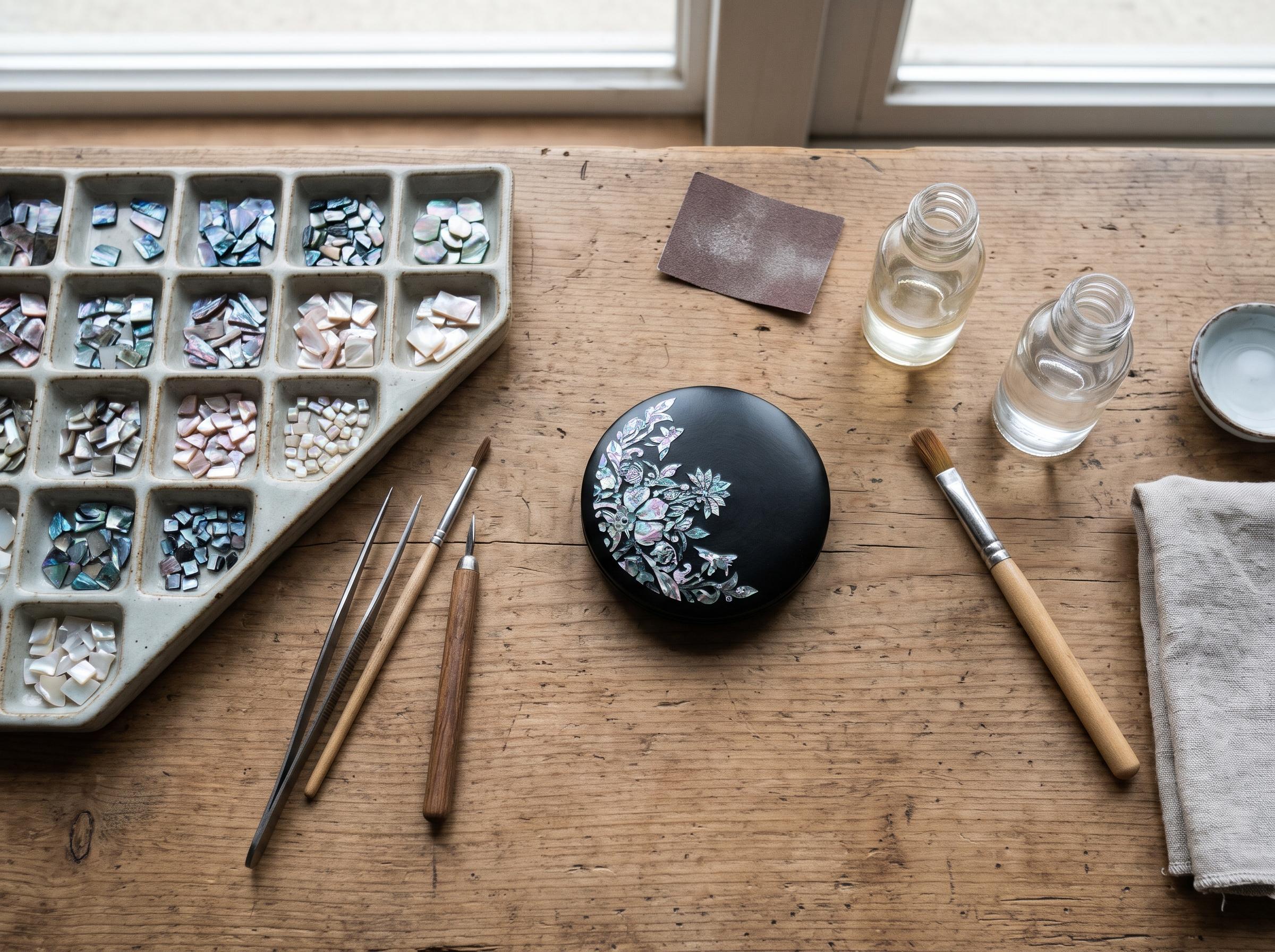
1. Base Selection & Design Concept (10–15 Minutes): Upon arrival, the instructor presents the day's blank canvas options—most commonly a matte or gloss black lacquer base on a metal-alloy compact mirror, an accessory tray, or an acrylic phone accessory45. You will examine sample pattern boards depicting classic Korean symbols—such as cranes (longevity), plum blossoms (resilience), or geometric lattice patterns—as well as modern Hangul typography stencils6. Instructors guide you to sketch or plan your composition dry on the table before committing adhesive4.
2. Inlay Positioning & Precision Adhesion (40–50 Minutes): Using ultra-fine jeweler tweezers, you pick up delicate fragments of iridescent mother-of-pearl (jagae, 자개)4. Because processed shell plates are naturally brittle and flat, placing larger pieces onto curved surfaces requires gentle micro-cracking techniques (ggeuneumjil, 끊음질) taught during the session to contour the shell seamlessly against the substrate. You position the fragments using clear craft adhesive or base resin, fine-tuning spacing under task lighting45.
3. Curing, Sealing & Packaging (10–15 Minutes): Once the composition is finalized, the instructor applies a durable topcoat—frequently an optical-grade UV-curable resin that hardens completely under an ultraviolet light chamber within two to three minutes7. This modern coating encapsulates the sharp edges of the shell fragments, delivering a smooth, glass-like protective dome7. While the final seal cures, studios often screen educational videos explaining historical Korean lacquer techniques, concluding the class by packing your finished piece into an embroidered pouch or gift box ready for luggage packing6.
Booking Checkpoints, Common Pitfalls, and Travel Logistics
A common mistake among international tourists is assuming that traditional artisan studios accept walk-in guests during regular retail hours. While gift shops attached to studios may remain open, structured English teaching slots require scheduled staff and preparation of materials. Private workshop operators typically lock class rosters 48 to 72 hours prior to the session45. If you plan to attend during Korea's peak travel seasons (April–May cherry blossom period or October–November autumn foliage), workshop timeslots on weekends frequently sell out weeks ahead.
Cancellation terms also vary significantly across ticketing channels. Platforms like Viator and Airbnb Experiences generally offer 100% refunds if canceled 24 hours prior to departure67. In contrast, regional travel reservation systems (such as Trazy or the Seoul Public Service Reservation Portal) often apply staggered cancellation penalties: full refunds require canceling 3 to 4 business days beforehand, with penalties of 30% applied for changes made 1 to 2 days prior, and zero refund for same-day no-shows45. Always cross-check the specific cancellation timeline and local emergency contact details before processing payment.
Frequently asked questions
Q. Can I take my completed mother-of-pearl craft item home on the same day?
A. Yes. While historical multi-step ottchil lacquerware requires weeks to cure, travel workshops utilize pre-coated base objects and fast-curing UV resin or clear sealants. Your finished piece is fully hardened and boxed to take home immediately at the end of the 60-to-90-minute session.
Q. Do I need to speak Korean to participate in these workshops?
A. No. The specific workshops highlighted—such as Jinjooshell, Hwiho Craft, Myeongdong accessory studios, and the official Seoul K-Craft international program—feature instructors who deliver step-by-step demonstrations and safety guidelines in English.
Q. Can children join a mother-of-pearl workshop in Seoul?
A. Most studios welcome children over five years old, provided an adult accompanies them. Note that certain private studios enforce strict capacity rules requiring both child and guardian to purchase separate craft items rather than allowing non-participating chaperones.
Q. How much does a typical English mother-of-pearl workshop cost in Seoul?
A. As of November 2026, prices generally range from 13,000 KRW to 15,000 KRW for subsidized public programs at Bukchon Traditional Crafts Center, up to 22,000 KRW to 75,000 KRW (approx. US$16 to US$55) for private studio workshops, depending on the item selected (e.g., hair tie vs. compact mirror or accessory box).
Sources
- [Tongyeong] MOTHER-OF-PEARL AND LACQUER CRAFTKorea Tourism Organization (VISITKOREA)
- Bukchon Traditional Crafts CenterSeoul Tourism Organization (Visit Seoul)
- 북촌전통공예체험관 / K-Craft Making ClassSeoul Tourism Organization (Visit Seoul)
- Mother of Pearl DIY Class in Bukchon Hanok Village, SeoulTrazy
- Mother-of-Pearl Craft Making Class in Seoul (Mon ~ Sat)KoreaTravelEasy
- Traditional Korean Mother-of-Pearl Craft WorkshopMarriott Activities / Hwiho Craft
- Mother-of-Pearl Jewelry workshop- seoulAirbnb Experiences
- Seoul: Traditional Mother-of-Pearl Accessory Craft Workshop.Trip.com
- Seoul Najeonchilgi Workshop 2026 | Booking GuideK-Culture in Korea