 Korea Experience Finder
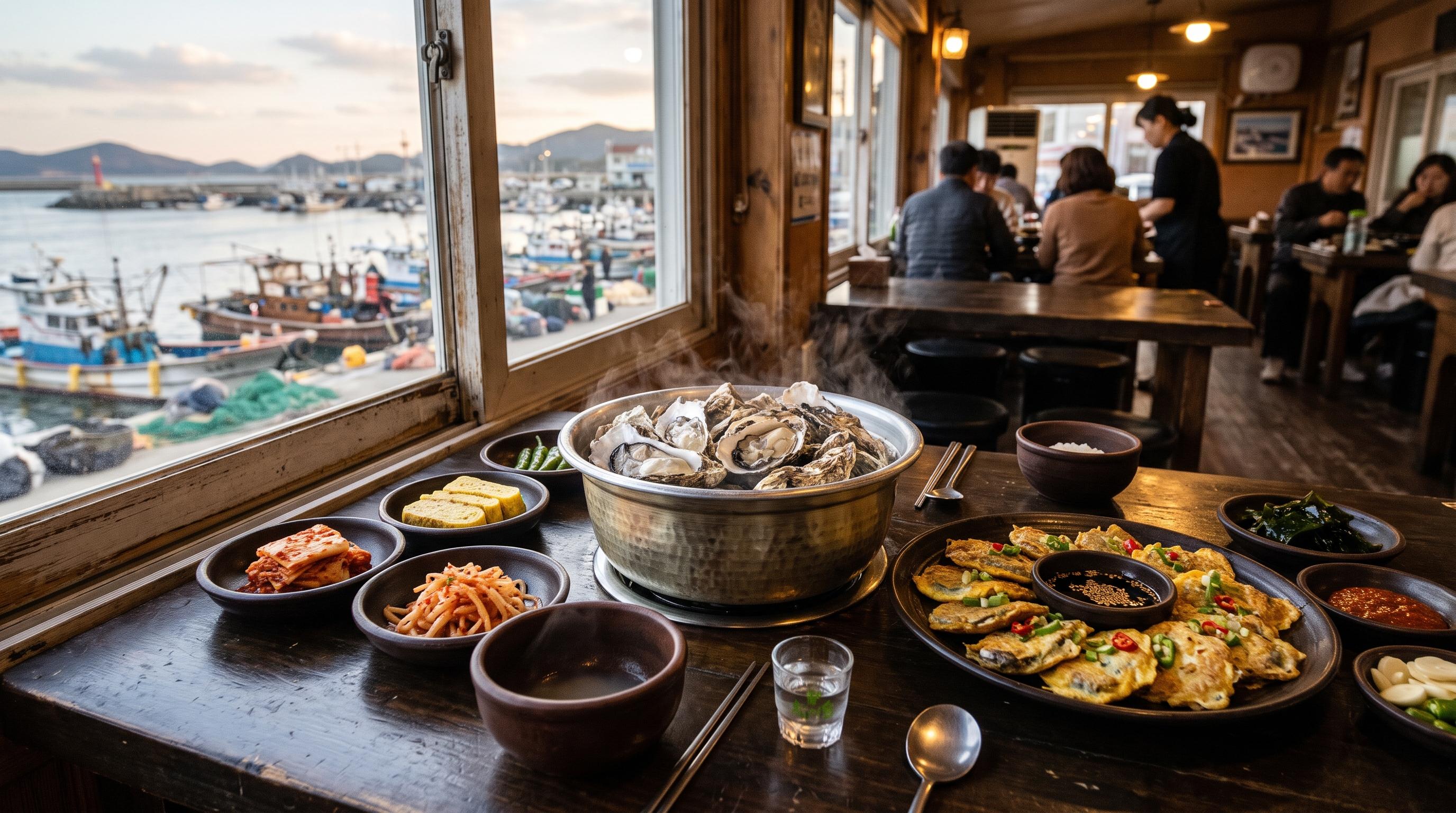
To enjoy Tongyeong oysters in winter, order a multi-course oyster feast (gul course) featuring raw, pan-fried, steamed, and rice dishes, or select piping-hot steamed bivalves cooked above 85°C for peace of mind.
- Guljeon (굴전): Pan-fried oyster fritters dipped in savory egg batter, best enjoyed immediately while warm.
- Gul-muchim (굴무침): Refreshing spicy-sour seasoned oysters mixed with matchstick radishes and aromatic herbs.
- Gul-gui / Gul-jjim (굴구이 / 굴찜): Fire-grilled or covered-steamed whole oysters, served with gloves and a paring knife.
The Capital of Korean Oysters: Why Tongyeong Dominates the Winter Catch
Every winter, seafood enthusiasts throughout South Korea turn their attention south toward Tongyeong, a coastal city in Gyeongsangnam-do defined by intricate ria coastlines and nutrient-rich waters. The coastal zone of Gyeongsangnam-do represents the beating heart of domestic oyster aquaculture, yielding 234,525 metric tons out of South Korea's total national harvest of 301,638 metric tons, which constitutes approximately 78 percent of national production volume1. Furthermore, regional production value accounts for roughly 197.7 billion KRW of the nation's 262.7 billion KRW oyster harvest1.
The local industry functions on an immense cooperative scale. The winter harvest cycle officially kicks into high gear during the cold months, running continuously through the spring. Local shucking facilities, known as baksinjang, employ experienced workers who extract plump meats from shells within hours of landing. For international travelers arriving between November and February, this operational rhythm guarantees that the bivalves landing on restaurant tables were harvested and prepared with exceptional freshness.
Decoding the Multi-Course Feast: What to Expect in a Gul Course
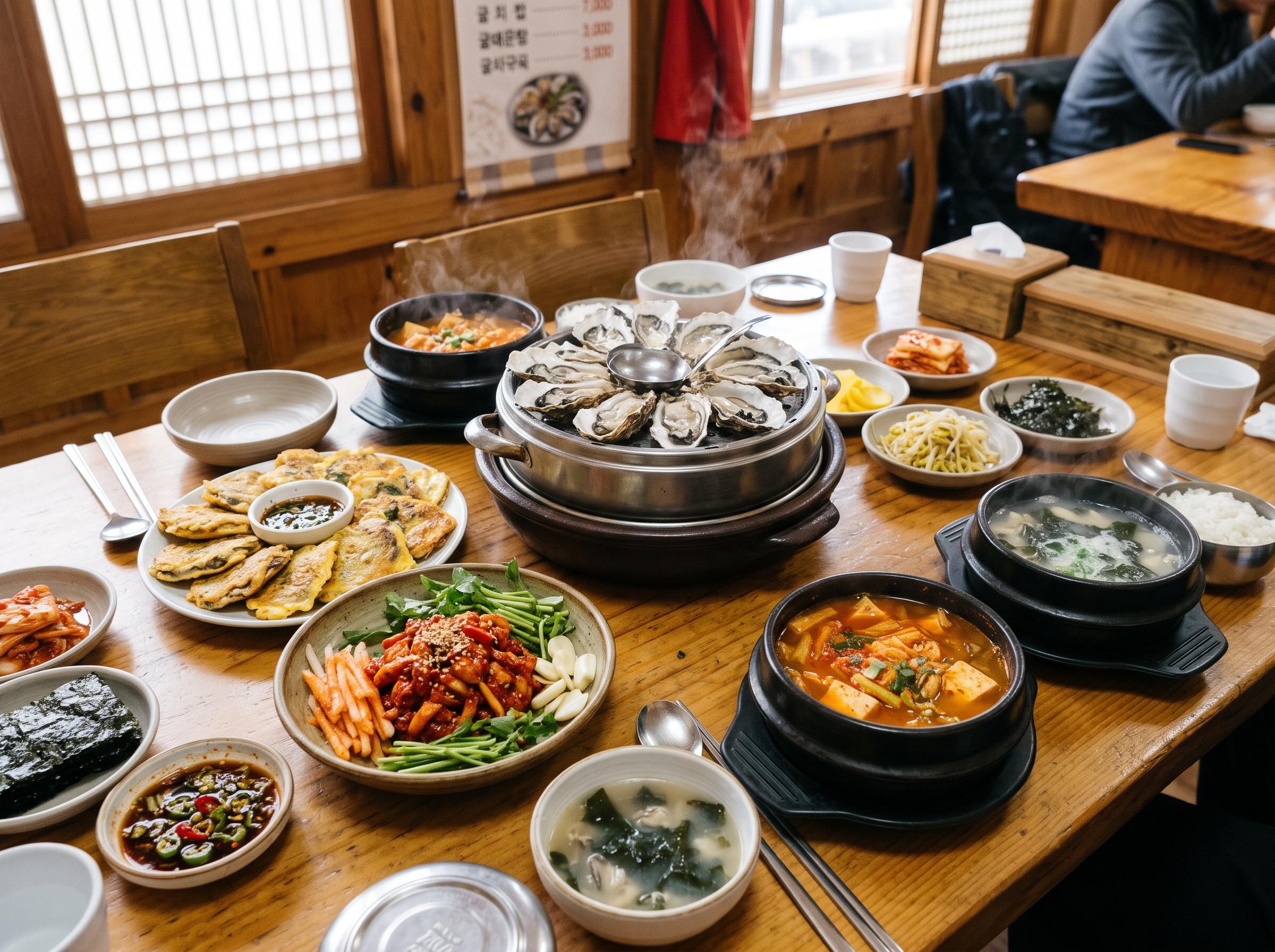
For travelers unfamiliar with specialized Korean shellfish restaurants, the simplest and most rewarding entry point is ordering a set menu known as a gul course (굴 코스) or gul jeongsik (굴 정식). Rather than offering only a single serving style, local specialty venues design an extensive banquet illustrating varied regional culinary techniques. This format allows diners to sample distinct textures and thermal profiles without having to decipher individual à la carte offerings.
A standard multi-course feast traditionally opens with saeng-gul (생굴, raw shucked oysters) served alongside sliced garlic, fresh chilies, and tangy chogochujang (vinegared chili paste). Next arrive guljeon (굴전), delicate pan-fried oyster pancakes dipped in light egg batter and minced scallions, accompanied by gul-muchim (굴무침), a zesty tossed salad balancing sweet-and-sour red dressing against crisp julienned radish, water dropwort, and tender shellfish. The progression ensures contrasting flavors, pairing rich batter crispness against the briny tang of raw seafood.
The hot dishes form the centerpiece of the meal. Tables receive either a massive steaming tray of whole-shell oysters (gul-jjim) or sizzling grilled shells (gul-gui), often accompanied by deep-fried oyster fritters (gul-twigim) served golden-brown with dipping sauces. The meal concludes with deeply nourishing carbohydrate staples, typically an individual hot stone pot of oyster rice (gulbap) tossed with seasoned soy sauce, sea greens, and sesame oil, or a comforting bowl of savory oyster porridge (gul-juk).
Comparing Dining Styles: Course Dining vs. Giant Shellfish Steamers
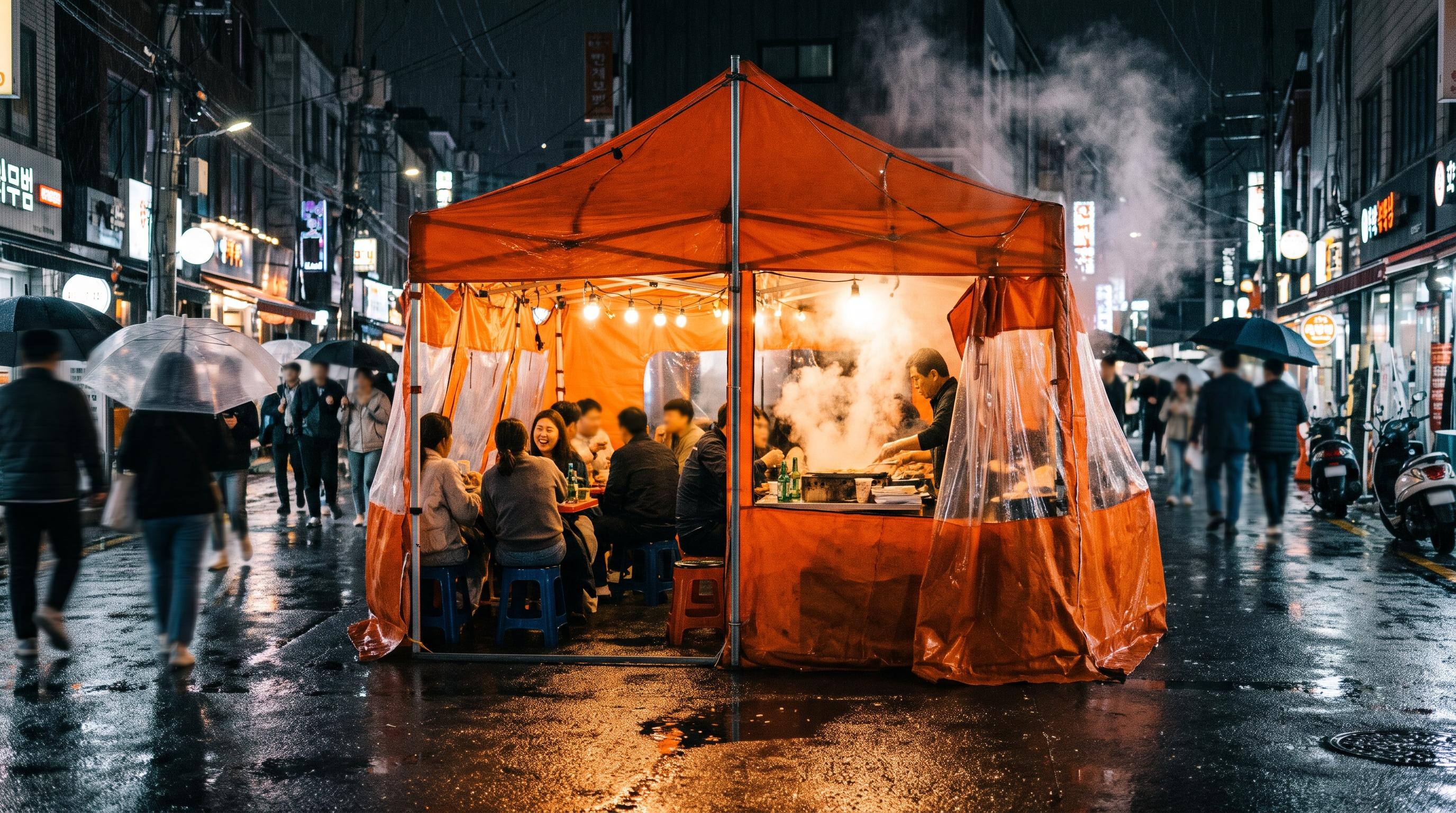
Visitors venturing through Tongyeong must choose between two primary dining formats: the structured course restaurant and the rustic steamer shack. Traditional specialty restaurants located near the harbor districts of Dongho-dong and Hangnam-dong focus on refined variety, delivering smaller portions of five to seven distinct preparations to seated tables. In contrast, massive seasonal tents and quayside warehouses near the outer bays specialize in gul-gui or gul-jjim by the tin, where entire galvanized buckets of in-shell bivalves are emptied directly onto table burners under heavy aluminum lids.
| Dining Style | Menu Format | Best Suited For | Key Preparation Methods | Dining Environment |
|---|---|---|---|---|
| Gul Course (굴 코스 요리) | Multi-course set banquet | Solo diners, couples, and first-time culinary travelers | Raw, pan-fried (jeon), spicy salad (muchim), fried (twigim), stone-pot rice (gulbap) | Heated indoor dining rooms with seated floor or table service |
| Steamed Tin / Grill Shack (굴구이·굴찜 전문점) | Bulk batch ordering (per tin or bucket) | Groups, hands-on diners, and winter late-night gatherings | Bulk whole-shell steaming or charcoal grilling with cotton work gloves and knives | Drafty waterfront hangars, industrial burner tables, and seaside tents |
| Seafood Market Shuck-and-Dine (중앙·서호시장 초장집) | By-the-weight raw purchase + seating fee | Budget travelers and adventurous market explorers | Fresh raw shellfish with dipping sauces and market side soups | Bustling open-market alleys and casual floor seating |
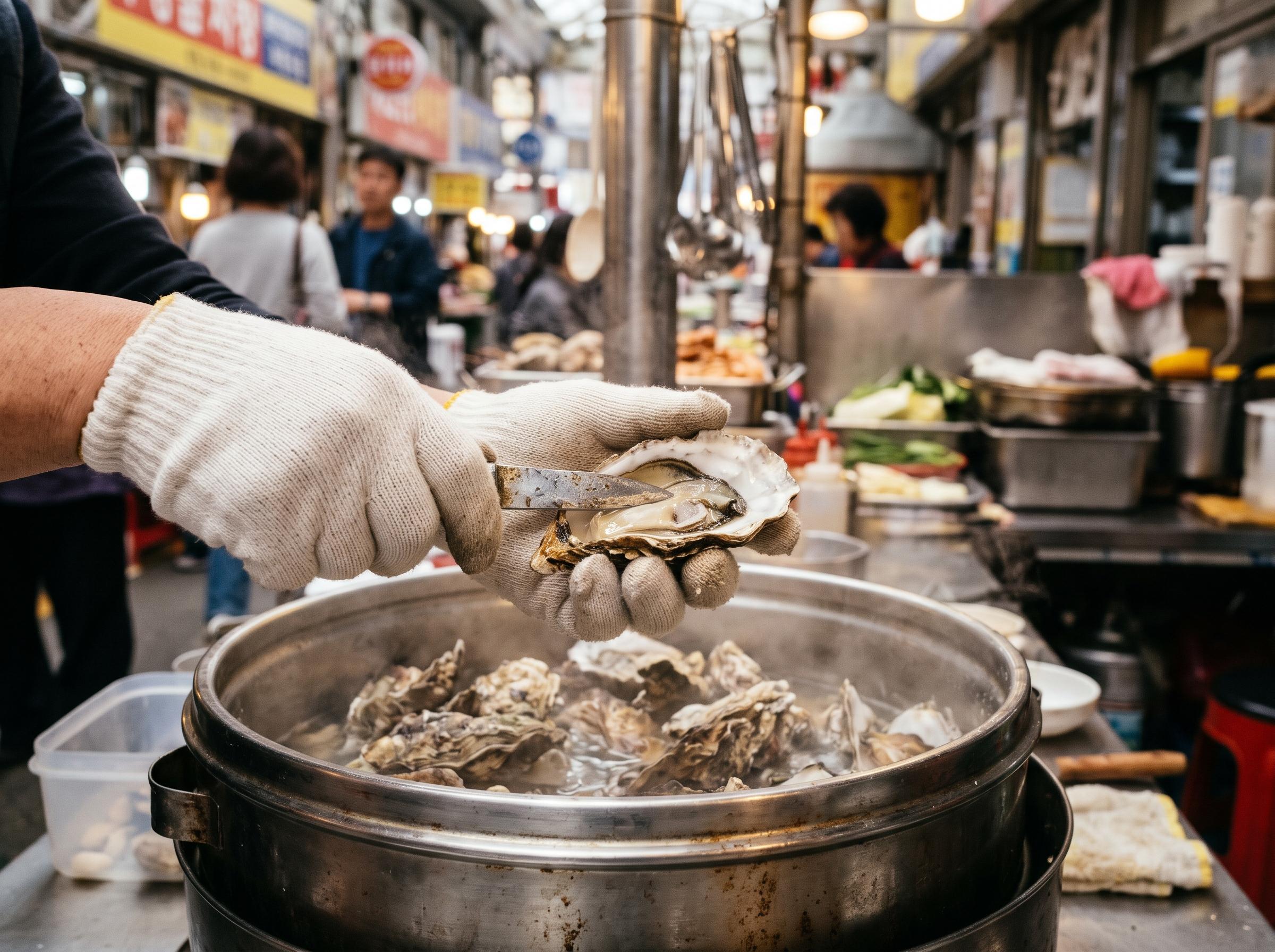
Choosing the right setting depends largely on group dynamics and dining priorities. Travelers traveling in pairs who wish to explore varied textures without labor-intensive shucking should opt for the structured course houses. On the other hand, groups seeking an atmospheric coastal ritual will appreciate the rustic grill shacks, where staff outfit diners with thick cotton gloves and blunt shucking knives to crack open piping-hot bivalves straight from the steam.
Essential Health and Safety Rules: Understanding Norovirus Risks
While fresh Korean oysters are renowned for sweetness, seasonal norovirus activity requires informed dining decisions. Norovirus is highly resilient at low temperatures and thrives during the cold winter months between November and April2. South Korea's Ministry of Food and Drug Safety advises that shellfish labeled for cooking must be heated until the internal core temperature reaches at least 85°C for a minimum of 1 minute to prevent food poisoning2.
Travelers with compromised immune systems, elderly individuals, pregnant women, or visitors with sensitive digestion are strongly advised by health guidelines to request fully cooked preparations, such as gul-jjim (steamed) or deep-fried gul-twigim, rather than indulging in raw saeng-gul. Hand hygiene is also critical; washing hands with soap under running water for at least 30 seconds helps minimize contact transmission2.
Step-by-Step Practical Ordering Guide for Foreign Travelers
Ordering at local Tongyeong establishments requires little Korean fluency if diners keep essential phrasing in mind. Most course restaurants require a minimum order of two portions (in-bun, 인분). When seating yourself, you can simply point to the course menu and state, 'Gul course i-in-bun ju-se-yo' (굴 코스 2인분 주세요, please give us two portions of the oyster course). If you prefer cooked alternatives to raw plates, politely request, 'Saeng-gul dae-sin igin geo-ro ba-kkwo ju-sil su it-na-yo?' (생굴 대신 익힌 것으로 바꿔 주실 수 있나요?, Can you swap raw oysters for cooked ones?), which most kitchens accommodate by frying extra pancakes or adding more steamed shells.
- Guljeon (굴전): Pan-fried oyster fritters dipped in savory egg batter, best enjoyed immediately while warm.
- Gul-muchim (굴무침): Refreshing spicy-sour seasoned oysters mixed with matchstick radishes and aromatic herbs.
- Gul-gui / Gul-jjim (굴구이 / 굴찜): Fire-grilled or covered-steamed whole oysters, served with gloves and a paring knife.
- Gulbap (굴밥): Steamed earthen bowl rice layered with oysters, ginkgo nuts, and seasoned soy-chili dressing.
- Chojang (초장): Red chili paste blended with vinegar and sugar, the quintessential dipping sauce across Korean raw seafood markets.
Payment throughout Tongyeong is universally smooth, with credit cards widely accepted at restaurants and seated market stalls. When dining near active market zones like Tongyeong Jungang Traditional Market or Seoho Morning Market, table seating operates from mid-morning until approximately 20:30, while specialized evening steam halls remain bustling until 22:00. Reserving ahead is rarely necessary for small parties on weekdays, though weekends in peak winter (December through January) frequently see queues form around noon and 18:00.
Frequently asked questions
Q. When is the absolute best time of year to visit Tongyeong for oysters?
A. The peak season runs from November through February, when coastal water temperatures drop, causing oysters to store glycogen, yielding maximum plumpness and sweetness.
Q. Can I substitute raw oysters in a course meal if I am worried about norovirus?
A. Yes. Most Tongyeong restaurants will readily substitute the raw oyster course (saeng-gul) with additional hot egg-battered oyster pancakes (guljeon) or extra steamed oysters (gul-jjim) upon request.
Q. What is the official cooking standard in Korea to ensure oysters are safe from norovirus?
A. According to the Ministry of Food and Drug Safety, oysters designated for heating should be cooked until their internal core temperature reaches at least 85°C for 1 minute or longer.
Q. What dishes are typically included in a standard Tongyeong oyster course?
A. A standard multi-course oyster feast (gul course) typically includes raw oysters, pan-fried oyster pancakes (guljeon), spicy-sour oyster salad (gul-muchim), steamed or fried oysters, and a finishing hot bowl of oyster rice (gulbap) or oyster porridge (gul-juk).
Sources
- ‘과밀 막고 품질 중심으로’…경남도, 자율관리 굴 양식체계 구축한다국제신문 (Kookje Shinmun)
- 어패류 85도 1분 이상 익혀 먹어야…겨울철 노로바이러스 주의대한민국 정책브리핑 (Korea.kr)