 Korea Experience Finder
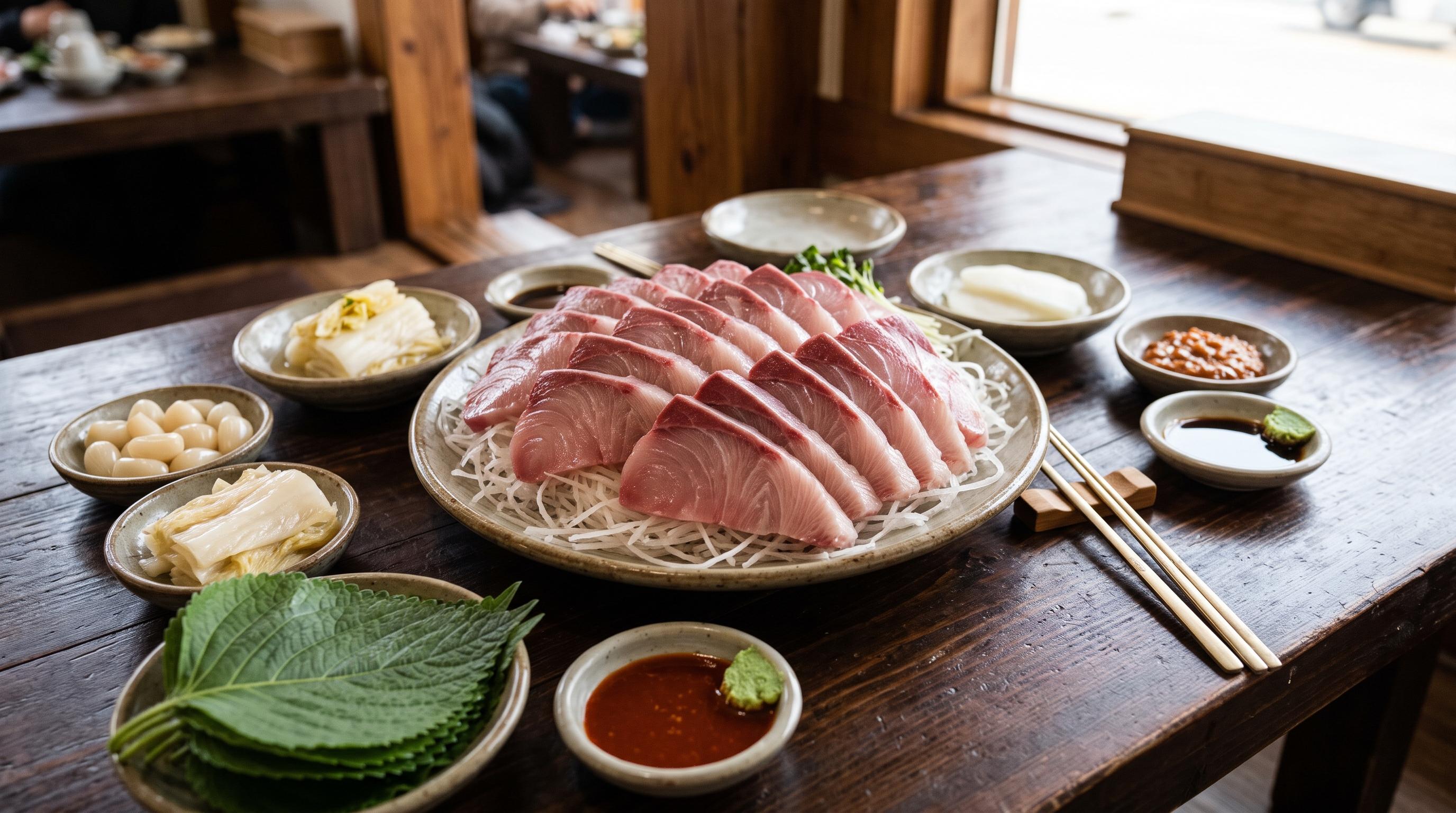
Foreigners can enjoy winter daebangeo by visiting wholesale hubs like Noryangjin, ordering portioned platters from live tanks, and dining at upper-floor prep restaurants.
The Winter Delicacy: Biology, Seasonality, and Size Classifications
Yellowtail, classified scientifically as Seriola quinqueradiata, undergoes an intense biological transformation as water temperatures drop across the East Sea and southern coast of the Korean peninsula. The Ministry of Oceans and Fisheries categorizes yellowtail according to strict weight classes: small yellowtail (sobangeo) weighing under 2 kg, medium yellowtail (jungbangeo) between 2 kg and 4 kg, and large yellowtail (daebangeo) at 4 kg and above1. However, in retail seafood market practice, vendors frequently reserve the premium culinary designation of daebangeo for specimens weighing at least 6 kg to 8 kg, which offer substantially thicker fat pads.
The species migrates southward along the coast toward Jeju Island and southern waters to prepare for spawning between February and April, when local sea temperatures reach 17°C to 20°C2. In the cold feeding window leading up to reproduction—specifically from November through February—yellowtail accumulate dense fat reserves that give the flesh its peak flavor2. This seasonal accumulation softens the muscle fiber and delivers a rich, buttery texture comparable to tuna belly.
Selecting the Fish: Whole Specimens, Shared Platters, and Origin Labels
Ordering daebangeo presents a logistical choice because a single 8 kg to 10 kg fish yields enough sashimi to feed eight to twelve people. Solo travelers, couples, or small groups should not attempt to buy an entire live fish. Instead, retail stalls divide large specimens into multi-cut platters (bangeo-hoe) or mixed sashimi trays (modumhoe). Purchasing a portioned platter from an active stall running high daily turnover ensures diners receive distinct anatomical cuts—including fatty belly (baetsal), firm back loin (deungsal), collar (moksal), and red muscle (saetgitsal)—without paying for an entire specimen.
| Category | Sourcing & Rearing Method | Fat Profile & Texture | Market Pricing & Distribution Dynamics |
|---|---|---|---|
| Domestic Wild (Guksan Jayeonsan) | Caught in cold natural waters around Jeju and East Sea | Firm muscle texture, clean fat profile, seasonal depth | Premium tier; highly valued by Korean consumers during peak winter |
| Domestic Ranched (Guksan Chuk-yang) | Wild juveniles transferred to coastal sea pens and fed to size | Consistent fat accumulation, tender texture, low parasite incidence | Upper-mid tier; popular for large group orders |
| Japanese Farmed (Ilbon-san Yangsik) | Full aquaculture life cycle under controlled commercial feeding | Uniform marbling, melting mouthfeel, exceptionally rich oils | Lower price tier; often traded at lower market wholesale prices due to consumer origin preferences |
Under Article 5 of the Act on Origin Labeling of Agricultural and Fishery Products, sellers must visibly display origin labels for raw fish on tanks, price boards, or retail packaging4. Japanese farmed imports generally trade at lower wholesale values in the Korean domestic market due to widespread local consumer preference for domestic wild catches. Because of this price gap, fraudulent practices have occurred where cheaper imported Japanese yellowtail was deceptively passed off as domestic Korean product, prompting researchers to develop metabolomic profiling techniques to distinguish geographic origin and enforce regulatory compliance6. International visitors should check tank placards to verify whether the fish is domestic wild (guksan jayeonsan), domestic ranched (chuk-yang), or imported farmed (ilbon-san).
Navigating the Market Floor: A Step-by-Step Purchasing Routine
At major seafood centers such as Seoul's Noryangjin Fisheries Wholesale Market, the high-grade live fish retail tier on the ground floor operates 24 hours a day, 365 days a year3. When walking into the market aisles, visitors should approach central stalls where fishmongers actively fillet large specimens on clean cutting surfaces. Under Article 44, Paragraph 1, Item 7 of the Food Sanitation Act, market merchants are legally prohibited from engaging in aggressive touting or soliciting customers by luring them in5. Separate commercial guidelines and pricing regulations mandate transparent price boards, so diners should bypass overly assertive vendors and choose stalls displaying clear digital scales and posted prices.
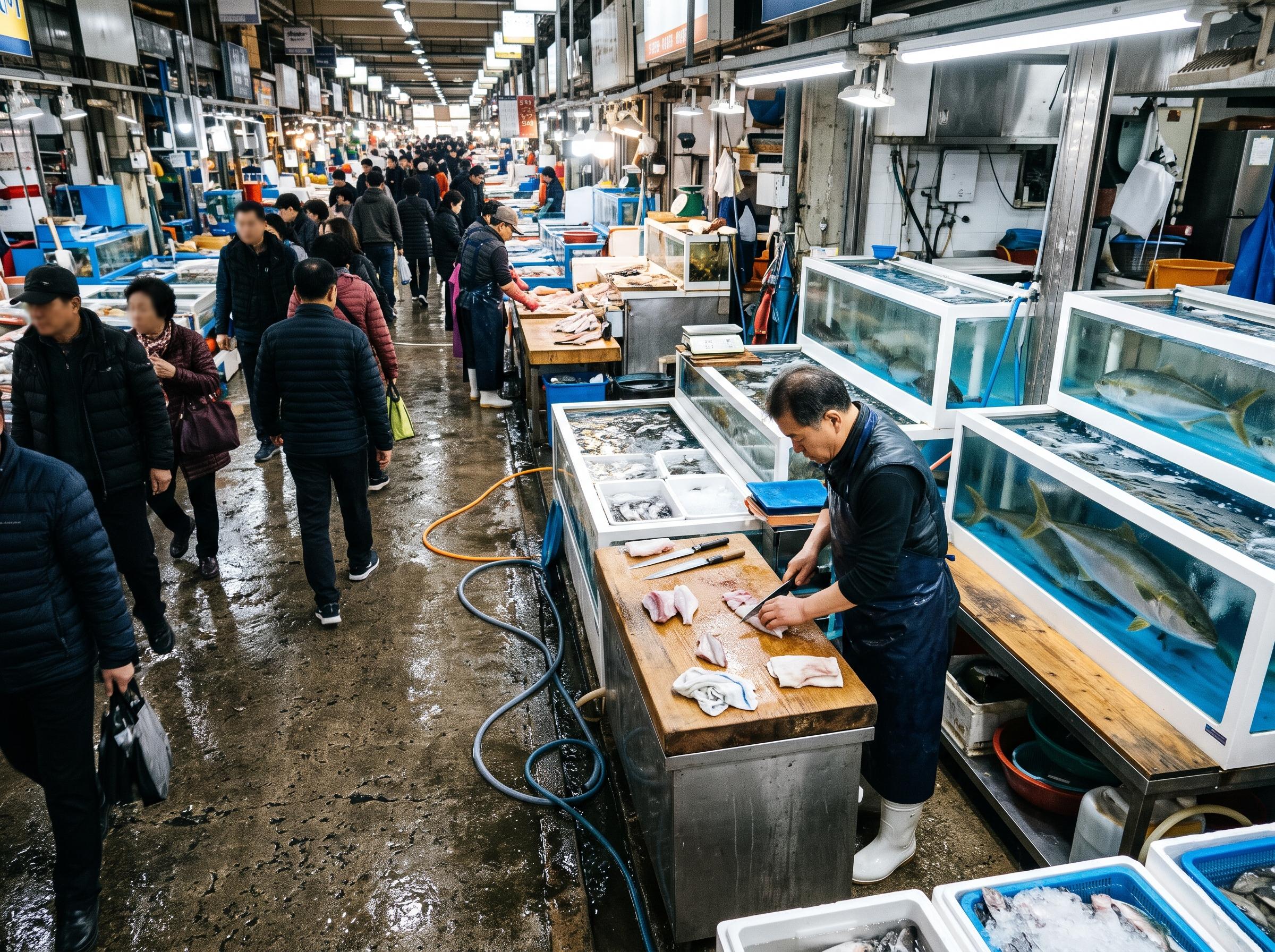
To execute the order, select either a pre-packed fresh platter chilled over crushed ice or request a custom plate sliced from a tagged hanging carcass. For two diners, an order of 500 to 600 grams of sliced daebangeo (typically ranging between 50,000 KRW and 80,000 KRW as of November 2026, depending on the inclusion of premium belly strips) provides an ample serving. Pay the fish stall directly using cash or an international credit card. Once payment is processed, inform the merchant that you intend to dine upstairs (sikdang-eseo meogeulgeyoyo). The fishmonger will pack the sashimi with wasabi and soy sauce, wrap the leftover carcass bones in a bag for soup, and assign an escort or provide a ticket directing you to an upper-floor prep restaurant.
The Chojangjip Experience: Decoding Fees, Kitchen Services, and Seating Rules
At traditional Korean fish markets, upper-floor dining halls operate under a collaborative market system. These dining businesses, commonly referred to as chojangjip or yangnyeomjip, do not operate primary fish tanks; rather, they provide table seating, dipping sauces, side dishes, and kitchen cooking services for customers who bring fresh seafood up from the retail stalls. Because these restaurants operate as separate commercial businesses from the market stalls below, diners pay a dedicated table fee and prep charges on a separate bill.
As of November 2026, the baseline table-setting charge (sangcharim-bi) is standardly 4,000 KRW to 5,000 KRW per person when ordering a hot stew, or 6,000 KRW per person if no cooked soup is requested. This fee covers access to raw garlic, green chili slices, ssamjang (seasoned soybean paste), vinegared chili paste (chojang), lettuce, and perilla leaves. Kitchen processing fees apply to supplementary cooking: having the kitchen stew your yellowtail bony frame into spicy fish soup (maeuntang) incurs a separate fee of 10,000 KRW to 12,000 KRW for a two-person pot, while salt-grilling the fatty fish head (daegari-gui) carries a preparation charge of approximately 10,000 KRW. Beverage purchases, rice bowls, and preparation fees will appear on the final restaurant bill separate from the fishmonger receipt.
Tasting Protocol: Side Dish Pairings and Regional Korean Flavor Profiles
Consuming cold-season daebangeo follows a distinct tasting progression designed to counterbalance the heavy intramuscular lipids. Unlike delicate white-flesh fish like flounder (gwang-eo), which shines with a simple touch of soy sauce, yellowtail possesses rich oils that quickly coat the palate. Korean sashimi culture pairs daebangeo with high-acidity, mineral-rich, or salty accompaniments to reset the tongue between bites.
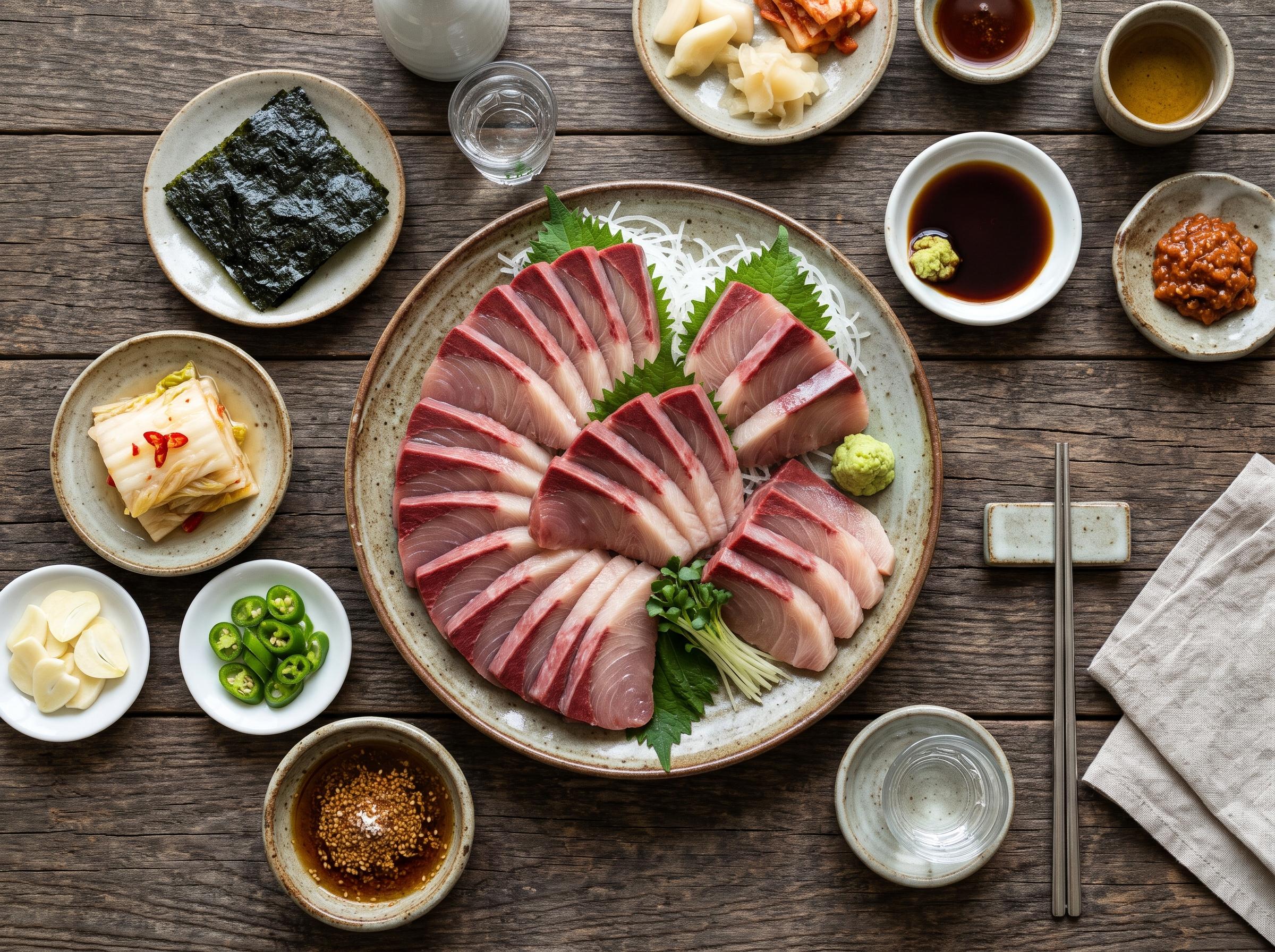
The traditional serving ritual begins by taking an unseasoned sheet of toasted seaweed (gim) and laying down a piece of washed, aged kimchi (baekgimchi or rinsed mugeunji). Place a thick strip of yellowtail belly on top, dab it lightly with ssamjang or salt-infused sesame oil (gireumjang), and fold it into a parcel with a sliver of raw garlic. The lactic acidity and effervescence of the aged cabbage cut right through the richness of the fish fat. For leaner back loin cuts, dipping the meat directly into fresh wasabi and dark soy sauce highlights the clean sweetness of the fresh fish without overwhelming its delicate profile.
Food Safety, Seasonal Boundaries, and Consumer Checkpoints
While winter yellowtail is prized for its high culinary value, strict seasonal boundaries exist. Outside the primary window running from November to late February, yellowtail begins its spring spawning cycle. By late spring and summer, particularly between June and September, the species carries a heightened risk of marine parasites and experiences significant muscular fat loss2. Diners visiting Korea during warmer months should steer clear of large yellowtail and opt for warm-weather seasonal seafood instead.
Inspect the final serving platter for pristine visual standards: the red muscle meat should display a bright ruby-to-garnet clarity without brown oxidation, and the belly cuts should exhibit an ivory sheen with firm, defined grain lines. Confirm that the fish carcass bag handed over by the vendor is carried straight to the kitchen counter to prevent cross-contamination. By recognizing standardized pricing structures, verifying legal origin markers, and following local pairing customs, foreign diners can savor authentic winter daebangeo at Korean fish markets with complete confidence.
Frequently asked questions
Q. What is the key difference between sobangeo and daebangeo?
A. Official classifications categorize sobangeo as yellowtail under 2 kg and daebangeo as fish 4 kg or heavier, though market vendors generally prefer specimens over 6 kg to 8 kg due to their significantly richer fat accumulation.
Q. Can two people order daebangeo without buying a massive whole fish?
A. Yes. Wholesale stalls regularly portion large 8 kg to 10 kg fish into single-plate assortments or mixed platters, allowing two diners to sample various cuts for approximately 50,000 KRW to 80,000 KRW without purchasing a whole fish.
Q. Why do upper-floor market restaurants charge a table-setting fee?
A. Upper-floor dining halls operate as separate service businesses. Their 4,000 KRW to 5,000 KRW per-person cover fee provides dining seating, side vegetables, dipping sauces, and cleaning services for seafood bought downstairs.
Q. Is it mandatory to order spicy fish soup (maeuntang) at the dining hall?
A. Ordering maeuntang is optional. However, if you choose not to order a hot soup, the per-person table-setting fee typically increases to 6,000 KRW, making the soup a cost-effective and warming addition.
Sources
- 자주 묻는 질문: 방어와 대방어는 어떤 차이가 있나요?해양수산부 (Ministry of Oceans and Fisheries)
- 동물: 방어 (Seriola quinqueradiata)서울대학교 해양저서생태학연구실 (Seoul National University Benthos Lab)
- 노량진수산시장 시설 및 영업시간 안내수협노량진수산주식회사 (Noryangjin Fisheries Wholesale Market)
- 농수산물의 원산지 표시 등에 관한 법률 제5조 (원산지의 표시)국가법령정보센터 (Korea Law Information Center)
- 식품위생법 제44조 (영업자 등의 준수사항)국가법령정보센터 (Korea Law Information Center)
- Analyzing the Metabolomic Profile of Yellowtail (Seriola quinquerdiata) by Capillary Electrophoresis–Time of Flight Mass Spectrometry to Determine Geographical OriginPubMed Central / Metabolites